Paul (3b48f63d)
Acts of the ApostlesPaul’s story is framed as a journey of witness: he carries the proclamation of the Realm through public resistance, anticipated imprisonment, and legal danger until he reaches Rome and continues preaching under house arrest. The book presents his persistence not as an escape from suffering, but as courage sustained by divine providence, with the Roman system itself becoming an unexpected means by which his mission reaches its destination.
Witness amid resistance
Paul’s testimony in Ephesus provokes a confrontation that places him and his companions in danger. Artisans drag them to the theater and behave threateningly after the message of the Realm has disrupted their world. The town clerk calms the crowd by pointing out that Paul and his companions are not lawbreakers. The episode sets witness, resistance, and providential support in a recurring pattern: the mission encounters real opposition, but the crisis does not have the final word.
That pattern recalls the account of Jesus in Luke, where the disciples hear that suffering lies ahead and are then given a momentary assurance of the Realm in the transfiguration. In the corresponding episode in Acts, public danger gives way to the clerk’s intervention. The parallel makes Paul’s experience part of a broader narrative design, inviting readers to recognize that witness may lead into resistance without leaving the community beyond God’s care.
The journey toward Jerusalem
The last part of Paul’s third missionary journey takes him from Ephesus through Macedonia and Greece, back through Macedonia, and onward by way of Troas and Miletus. His travels are more than movement between places: visits encourage believers, and when a plot is made against him, believers help provide safe passage. Some arrive ahead of him in Troas to prepare for his coming. The journey thus depicts the mission as sustained by a network of communities, not by Paul’s efforts alone.
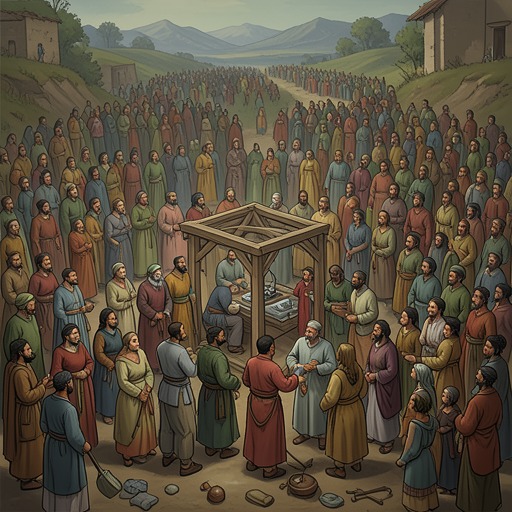
At Miletus, Paul summons the elders from Ephesus. They make the twenty-five-mile journey to meet him, and his farewell address becomes a reckoning with both his work and the dangers facing the community. He recalls enduring trials and continuing to offer repentance to Jewish and Greek people. The Spirit has revealed that imprisonment and persecution await him in Jerusalem, yet he hopes to finish his course. His resolve gives weight to his counsel: he speaks as one who has not turned away from suffering when the mission demanded endurance.
Paul warns that the congregation will face threats from outside and from within. He describes the community as a flock and its leaders as shepherds and overseers, responsible for keeping it together, feeding it, tending its wounded, and guarding it against predators. The image connects Paul’s own vulnerable journey with the elders’ continuing responsibility: his departure does not remove the need for attentive leadership or make the community safe from those who distort the truth.
Calling and defense
Paul’s calling to the Gentiles is a defining thread in his story. The narrative returns to his experience on the Damascus road three times, giving the repeated account particular weight. In his defense before a Jewish audience, Paul stresses his Jewish roots and his former persecution of the Way, then recounts his transformation from persecutor to preacher. His appeal to shared history makes the change in his life part of the argument: the same sincerity evident in his former opposition, he maintains, should be recognized in his present witness.
The account presents Paul’s Gentile mission as a prophetic commission, echoing the call of Isaiah, and places it under the aegis of the Jerusalem council. The mission is therefore not portrayed as a private venture detached from the wider movement. Paul’s public defense joins his own life story to a larger authorization and purpose: he has been called to carry the message beyond its earlier boundaries.
Roman custody and the appeal
In Caesarea, Jewish leaders bring charges against Paul. He answers that he has committed no offense against Torah, the temple, or the emperor. Festus, seeking to favor the Jewish leaders, asks whether Paul would agree to be tried in Jerusalem. Paul instead appeals to the emperor’s tribunal. As a Roman citizen, he has a right to have his case heard by the emperor; the narrative’s legal terminology is debated, but the appeal functions clearly in the story as a request to transfer the case from Caesarea to Rome.
The account’s emphasis falls less on the technical classification of the appeal than on what it accomplishes. Paul is not depicted as acting from fear of death: elsewhere he has expressed readiness to die. His concern is that witness to the Realm has not yet reached Rome, a destination toward which the narrative has been moving. The appeal frustrates the plot against him and opens the route to the imperial city. Roman authority, though part of an unjust and violent empire, becomes an instrument through which the mission proceeds.
This episode extends a recurring tension in Paul’s story. He is held within Roman power, yet that power does not wholly control what his custody will mean. The appeal turns an adverse circumstance into a passage toward the mission’s goal, illustrating the narrative’s insistence that providence can work through institutions that do not themselves embody the Realm.
Rome and the unfinished witness
After the sea journey and winter in Malta, Paul sails for Rome aboard a ship whose figurehead represents Castor and Pollux, the twin sons of Zeus whom many regarded as protectors of seafarers. The narrative’s interpretive contrast is deliberate: safe passage comes from God, even if the journey’s ship bears symbols of other gods. The episode belongs to a wider pattern in which God can use people and circumstances that do not share the mission’s faith.
In Rome, Paul encounters believers and, while under house arrest, meets local Jewish leaders. He explains the charges that brought him there; they listen. When disagreement arises in the Jewish community over whether to accept his witness, Paul draws on Isaiah to announce that the news of the Realm will now go to the Gentiles. His imprisonment limits his freedom but does not silence his proclamation.
The book closes with Paul living in Rome for two years and proclaiming the Realm. The ending brings the journey’s geographical aim to completion while leaving the witness active: Paul has reached the imperial center, but the message continues beyond the point where the narrative stops. His trajectory binds personal courage to communal mission and makes Rome, the seat of the power that confines him, the setting for the continuation of his testimony.